slideshow 6 slideshow 1 slideshow 2 slideshow 3 slideshow 4 slideshow 5 slideshow 7 slideshow 8 slideshow 9

UA Professor Linda Powers, shown here in the Arctic with one of her instruments, is taking her portable technology to a new level: diagnosing blood-borne disease.Building on research that sent her biking across Tanzania a couple of summers ago to test remote water sources on the spot for bacteria, University of Arizona Professor Linda Powers is moving into the diagnostic realm. The Thomas R. Brown Distinguished Chair in Bioengineering is developing fast, disposable blood tests for pathogens that cause diseases such as HIV and hepatitis.

The novel technology for rapid pathogen detection in blood relies on the capture of the pathogens with specially designed binding mechanisms and the intrinsic fluorescent signatures of the live captured   pathogens. 

"This will save time, work and expense when detection of blood-borne disease organisms is needed and other facilities are not available," said Powers, who holds appointments in... Read Complete Article


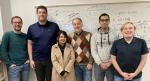
A UA research team made up of (from left to right) Tao Qin; Xiong Wang; Yexian Qin; Hao Xin, principal investigator; Russell Witte, co-principal investigator; and Pier Ingram will apply their new breast cancer imaging technology to bomb detection.The kind of mayhem caused by homemade explosives, both domestically and overseas, likely will involve high-tech systems that can identify concealed bombs from a distance. With a recent $1.5 million U.S. Department of Defense award, University of Arizona researchers will adapt their breast cancer imaging research for detection of embedded explosives.

Electrical and computer engineering professor Hao Xin, principal investigator on the Defense Advanced Research Projects Agency, or DARPA, award, says the same advanced technology he and his colleagues have been creating for early breast cancer detection is... Read Complete Article


Salim Hariri accepts a UA Technology Innovation Award for his work in cybersecurity.Salim Hariri, professor of electrical and computer engineering and UA site director for the National Science Foundation Center for Cloud and Autonomic Computing, is considered to be among the best of the best when it comes to University of Arizona innovators. Hariri, who has developed a cyber-nervous system to protect against cyber-attacks, and five of his UA colleagues recently received UA Technology Innovation Awards recognizing their entrepreneurial contributions.

During the awards presentation and panel discussion on March 28, 2013, Hariri advised young researchers to focus on work that reaches the masses and makes a difference. The litmus test, he said, is whether the work will result in something “somebody can pick up and use.”

Recent advances in computing, networking, software and mobile technologies have led to the development of cyber-resources, such as cloud computing, that are significantly changing the way we do business,... Read Complete Article


For the tech community, upcoming IEEE Computer Society Conference in Scottsdale features ECBS tutorials on robotic systems, software security, and more.

Boeing 787 Dreamliner cockpitWhen Boeing had the unfortunate malfunction of its lithium-ion battery in its 787, engineers at the University of Arizona knew what could be grounding the Dreamliner. The airplane was an “example of a device that is so complicated and complex, that you don't know whether it works until you build it,” said Jonathan Sprinkle, UA professor of electrical and computer engineering and a chair of the upcoming 20th Annual IEEE International Conference and Workshops on the Engineering of Computer-Based Systems.

Boeing’s troubles and other enterprises controlled by computers are part of a special class of technological challenges relating to the engineering of computer-based systems, or ECBS. Systems once handled by... Read Complete Article


University of Arizona College of Engineering